Saved, til morning
Get it out of your head without waking yourself up
You wake at 2am with something you can’t let go of. Reaching for a normal notes app costs you a bright screen, the time, and an hour of sleep you don’t get back.
One button, and nothing else to look at
The night screen is almost empty on purpose. No clock, no list, no settings, no way to read anything back. The only thing you can do is say the thing and put the phone down.
Near-black, red-tinted, no white light
About three percent of the screen is lit. Nothing in the flow flashes white, including the moment it launches.
Speak, and the sun lifts a little
The disc rises while you talk, so you know it heard you without reading a word. Type instead if you’d rather.
Then it tells you it’s safe
One soft tap of haptic, the sun settles, and the screen says “Saved, til morning”. That is the moment your brain is allowed to let go.
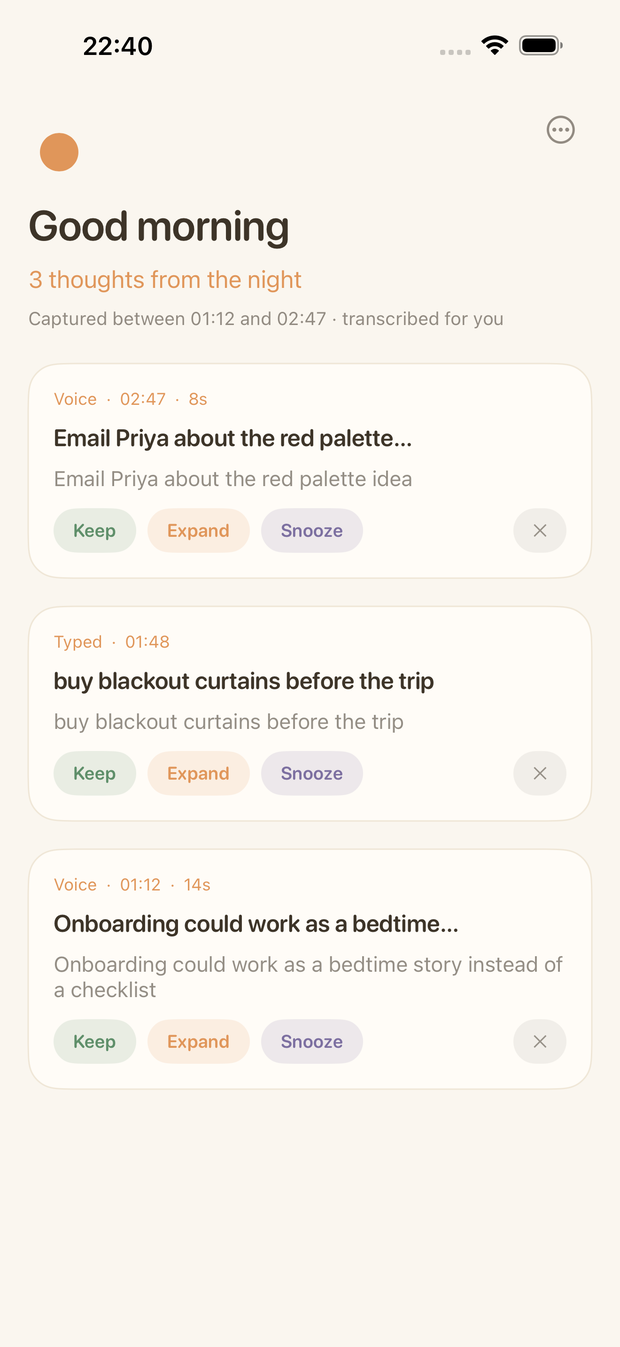
In the morning
The app changes face while you sleep
Everything you said is there in daylight, transcribed and timestamped, ready to deal with when you actually can. The sun that was a sliver at 3am has cleared the horizon.
Keep it, snooze it, send it on, or let it go
One tap each. Snoozed notes come back tomorrow. Nothing sits there quietly making you feel bad.
A count, never the contents
The morning notification says how many notes are waiting. What you said at 2am never appears on your lock screen.
Your hours, not ours
The dark face runs 9pm to 6am by default. Change it to whatever your nights actually look like.
Writing it down is the part that lets you sleep
In a sleep lab at Baylor University, 57 adults spent five minutes writing before bed, wired up for polysomnography. Half wrote about what they had finished that day. Half wrote down what they still had to do.
The ones who offloaded the unfinished things fell asleep roughly nine minutes faster. The more specific the list, the faster they dropped off.
A thought you are still holding at 2am is one your brain refuses to release, because releasing it means losing it. Getting it out of your head is the release.
Everything else about ’Til Morning exists so that release doesn’t cost you the rest of the night: no bright screen to reset your body clock, no clock face to start the arithmetic of how little sleep is left, nothing to read, nothing to scroll, nothing that can turn a thirty second thought into an hour of being awake.
It is not a sleep tracker and it will not diagnose anything. It does one thing, at the one moment that matters.
What you say at 3am stays on your phone
Not a policy we grew into. There is no network code in the app at all.
Install it and use it. There is nothing to log into, which means there is nothing of yours sitting on a server.
Your phone’s own speech recognition does the work and the audio never leaves it. The Android build ships without internet permission, so the system cannot open a connection even if something asked it to.
Export one note or all of them as Markdown, times intact. Leave whenever you like and take the lot with you.
Say it, sleep, read it in the morning
Free to capture, for as long as you use it. Coming to both stores shortly. Send an email if you want to know the day it lands, or if you would like to break it for me first.